Introducing CO01
Experience is
the prompt
“For the things we have to learn before we can do them, we learn by doing them.”
Aristotle, Nicomachean Ethics, Book II, Chapter 1, translated by W. D. Ross
We humans learn new skills with help from parents and teachers, then get better through practice, feedback and failure. We believe Physical AGI should learn this way too. CO01 is a robot model built on that idea. Show it a new task once, or give it a few pointers, and it adapts on the spot, with no task-specific retraining. It learns from the experience placed in its context: demonstrations by people or other robots, filmed from their own point of view or from the side; its own earlier attempts and how each one turned out; guidance by voice, by gesture or by a change to the scene; and anything else that helps, such as a picture of the goal. A robot that learns this way is useful long before it has been taught everything.
1Experience prompting
In 2020, GPT-3 showed that a language model could take on a new task from a few examples in its prompt [1]. This is in-context learning. In this post we use the term broadly, for any behavior a model picks up or adapts from experience at the moment of use, without any change to its weights. Robot models have begun to show a narrow form of it. Show them a few demonstrations of a new task, and they can sometimes carry it out [2, 3]. CO01 widens it in two ways. Its context is not limited to demonstrations, and its demonstrations are not limited to its own body or viewpoint.
For CO01, a demonstration is only the start of the lesson. A person can show the task with their own hands, let the robot try, and give feedback along the way. The robot uses all of it together, so its next attempt draws on more than imitation.
Experience prompting is how we put that experience in front of CO01. Each kind tells it something different about what to do next. A demonstration shows the goal. A failed attempt shows what to change. A correction adjusts a motion already under way. Figure 1 shows how this compares with what other robot policies learn from.
We want people to put our robots to work on tasks we never anticipated. For that, teaching a new task has to become part of using the robot, and part of building it. The people who use a robot should be able to show it a new task on the spot, and the team developing it should be able to add one without a new round of data collection and training. That makes learnability part of performance. What a robot can already do matters, and so does how easily anyone can teach it something new.
What a robot policy can learn from
What three kinds of policy take as context.
2Experience prompting in action
Here we change the experience CO01 receives and watch what it does with each kind. Section 3 puts them together in one long task.
2.1From a demonstration
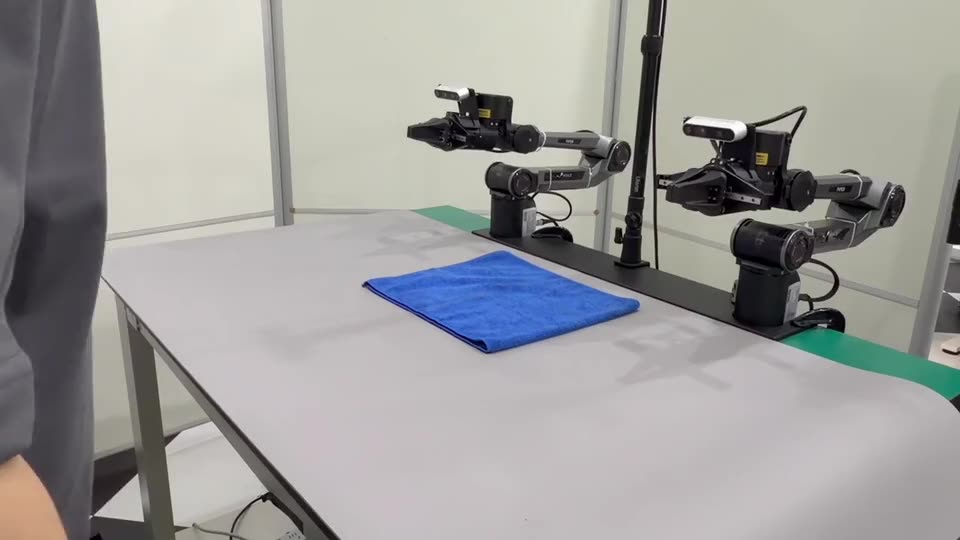
Teaching a robot a new task usually means collecting around a hundred teleoperated demonstrations and fine-tuning a policy on them. Earlier one-shot imitation methods got by with one, but only within the narrow family of tasks they were trained on [4]. CO01 needs one or a few recordings, and it does the task in its own scene with its own body. In Video 2, notice that the goal carries over while the motion does not. The robot's grasps, paths and timing differ from the person's, and the scene often differs too.
A person shows the task; the robot does it
Four tasks. Where the person's demonstration was filmed, it plays in the corner.
New scenes, other towelsThe person folds one towel in half; the robot folds a different towel the same way, at two different tables.
Folds combinedTrained on single folds; shown two in a row, it makes both, in order.
From the sideThe person picks up a USB cable, passes it from one hand to the other and plugs it into the charger on the power strip. The robot does the same with its two grippers, handover included.
Head cameraThe same demonstration and run, each seen from its own head camera.
Step by stepThe person builds on their side, a step at a time; after each step the robot builds the same with its own blocks.
Played backwardsA person builds a shape; the corner shows it as filmed. The robot is given that recording played backwards, and takes the shape apart. The two shapes play in turn.
Same orderPresses the same colors in the same order, using the buttons on its own side.
Point and pressPresses each button as the person points to it.
To check that the demonstration really steers the robot, rather than the robot doing something it already knows, we set up scenes with two equally sensible goals and change only the demonstration: the same buttons pressed in a different order, or the same towel folded into a triangle or in half (Figure 2).
What to do: same buttons, two orders
Each rollout sees one of the two demonstrations, shown in its corner
96%of rollouts follow the order shown
 Same start
Shown
Shown
How to do it: same towel, two folds
Each rollout sees one of the two demonstrations, shown in its corner
92%of rollouts follow the fold shown
 Same start
ShownCorner to corner
ShownEdge to edge
Next, we move further from training: scenes from an exact match to a different tool doing the same job (S0–S3), and tasks from familiar to never seen (N0–N2).
One demonstration in context vs. a language instruction, by distance from training
Success rate on our internal in-context benchmark; bars show 95% intervals
How far the scene moves
The task is known; the scene changes
How new the task is
The scene is matched; the task changes
Finally, the biggest win from a demonstration in context is speed. We fine-tune the same pretrained model on more and more demonstrations of the same unseen tasks and count the time from collecting them to a working policy (Figure 4).
How long a new task takes: in context vs. fine-tuning
Average success on a separate set of held-out tasks, same pretrained checkpoint. Time counts collecting the demonstrations and training on them; band is the 95% interval.
2.2From its own experience
Some things only become clear once the robot acts: whether a test tube fits its hole, whether a lid goes on straight. A policy that throws away a failed attempt may make the same mistake on the next try. CO01 keeps its earlier attempts at the current subtask in context and uses them to adjust the next one. Having seen many sessions in which a failed try is followed by a better one, it has learned what a failure says about what to change. In Video 3, compare a run where the robot keeps its earlier attempts in context with one where it does not.
Failed attempts, then a better one
Two tasks where only trying shows what is wrong. Compare runs with earlier attempts in context against runs without them.
Attempts kept in context
✕✕✓Not the left rack, not the right; the tube goes in the blue one.
Attempts not kept in context
✕✕The same rack twice, then the tube falls over.
Attempts kept in context
✕✕✕✓The lid will not go on three times; the fourth time the box closes.
Attempts not kept in context
✕✕✕The lid lands crooked every time, and the box stays open.
The benefit already shows up in training: with its earlier attempts in context, the model reaches the other model's best loss after about 4,600 training steps instead of 12,500 (Figure 5a). On the robot, we pick tasks where the first attempt often fails, allow up to five attempts, and compare the robot's own earlier attempts in context with a failed attempt from an unrelated task and with no history at all (Figure 5b).
Earlier attempts in context: lower loss in training, more successes on the robot
Tasks where the right move is found by trying
(a) In training
Action loss on held-out multi-attempt sessions
(b) On the robot
Cumulative success by attempt; bands are 95% intervals
2.3From guidance
People often teach through small nudges in the middle of a task: "a little more to the left," a finger pointing at the right drawer, a hand guiding the learner's wrist [5]. Most robot policies take their instruction once, up front, so changing anything halfway means stopping the robot and starting over. CO01 takes guidance while it works, whether that is a few words, a gesture or a change to the scene, such as a coaster set down where the cup should go. In Video 4, watch the change take effect in the middle of a motion, and watch it stick after the person stops guiding.
Guidance while it works, kept afterwards
A person steers the robot mid-task, by changing the scene or by gesture. Hover or tap a mark to see the guidance.
Guidance given
Round 1Its default: in order, whatever the color.
Round 2A person points out which cup goes on which coaster; the robot follows.
Coasters shuffledKeeps the pairing without being shown again.
Round 1Its default: the cup goes on the rack.
Round 2A coaster appears mid-task; the cup goes on it, not the rack.
Round 3The same steer again, with a new cup and coaster; the cup goes on the coaster.
Guidance sticks because the policy's context holds its interaction history within the episode, and across sessions the orchestrator saves preferences like this to memory.
2.4Across robots
Experience does not have to come from the robot that uses it. A rollout recorded on one robot can also become context for another whose arms, hands and cameras differ: the goal and the order of steps carry over, while the grasp and the reach have to suit the new body. We are starting in simulation. In Video 5, two arms at a table sweep scraps into a dustpan. That rollout is the prompt for a robot on a wheeled base, and its rollout in turn prompts a humanoid. Others have shown a related effect, using simulated rollouts as prompts for real robots [2].
One task, relayed across three robots
Each robot's rollout is the next robot's prompt. Sweeping scraps into a dustpan, in simulation
Two arms at a tableIts rollout starts the chain.
Wheeled basePrompted with the two-arm rollout.
HumanoidPrompted with the wheeled robot's rollout.
3Putting it together: a long task
Making a cup of milk tea at a drink station takes many steps over several minutes, which makes it a useful first test of how the pieces of CO01 fit together. A person made the drink once at the station, and that recording became the prompt. What follows is an early proof of concept, not a finished capability. It shows how CO01 approaches a long recording: breaking it into subtasks, following them in order and drawing on the kinds of experience from Section 2 along the way. Making long tasks dependable is a focus of our next release.
3.1An orchestrator and a policy
Different experience stays useful for different lengths of time. The user always takes the blue cup holds for months, the ice bin is nearly empty for minutes, the jug is heavier than it looks for a tenth of a second. One context window cannot serve all three, so CO01 splits the work, and the context, between an orchestrator and a policy.
The orchestrator is a vision-language agent that keeps long-term memory, plans, calls tools and checks progress, as general-purpose agents now do over long sessions [6]. In the milk-tea run, it split the person's recording into eight subtasks and built an experience prompt for each: the recording, plus whatever else the subtask needed, such as the robot's previous attempt, a request the user made a minute ago or a picture of how the subtask should end.
The CO01 policy is a video-action model. In training, it learns to predict both how the scene will unfold and what the robot should do next [7, 8]. Predicting the scene teaches it how things move, which it needs to read a demonstration recorded by someone else (Section 5). At deployment it generates no video. It reads the experience prompt, its live cameras and metadata such as which robot is acting, takes in corrections and its interaction history as they arrive, and outputs actions at control rate.
An orchestrator and a policy, connected by experience
The orchestrator deals each subtask a hand of experience; the policy reads it alongside its live cameras and acts at control rate.
Splitting a robot into a slow planner and a fast controller is not new [9, 10, 11, 12], and general-purpose models already show that robots can learn from experience in context [13, 14]. What sets CO01 apart is what passes between the two. Most hierarchical systems send a short language command, which says what to do but loses how. As Polanyi put it, "we can know more than we can tell" [15]. Few people could explain in words how to tuck in a fitted sheet, but a ten-second clip shows it. So the orchestrator hands over the experience itself, and the policy, trained to read it, does the interpreting.
3.2One run, step by step
Figure 7 lines up one run against the person's demonstration. In this run, the robot followed the same eight steps in the same order.
Another run needed more, and the policy took it in as it worked: asked for less milk powder, it tipped some back from the spoon it was already holding, and when the tea bag caught on the rim of the cup, it tried again until the bag went in.
Milk tea from one demonstration, step by step
The robot's run (top) against the person's demonstration (bottom), on one clock. The clips show four of the eight steps.
Milk powder0:08 · demo 0:06
Water0:25 · demo 0:13
Pearls1:58 · demo 0:48
Into the cup2:23 · demo 0:55
4Building experience
A model only learns to read its context if, during training, the context helps it predict what comes next. Language models get this almost for free, because the web is full of documents in which earlier text explains later text, and in-context learning shows up when related examples arrive in bursts [16, 17]. Robot data rarely looks like that. Pipelines sample one episode at a time, and the sessions in which a robot fails and tries again, or a person steps in, usually get trimmed away. We built CO01's data around exactly that structure.
4.1Sessions, not episodes
CO01's data comes in sessions: everything that happened around one task, kept in order and linked to related experience recorded elsewhere (Figure 8 shows how it divides by source and by kind of session). The main kinds are:
- Paired demonstrations. The same task done by a person or another robot, matched to the robot's own episodes: first-person or side video of people, other robots, UMI handheld grippers [18], simulation and video generation.
- Multi-attempt sessions. Ordered tries under the same conditions with the failures kept, so the model sees improvement happen across attempts, as in Algorithm Distillation [19].
- Interactive sessions. A person corrects, redirects or states a preference, by speaking, pointing or nudging the arm, recorded with what the robot did before and after.
- Single episodes. Ordinary demonstrations and rollouts, which keep the model's skills in its weights.
What CO01 is trained on
Share of training hours
4.2Collected, annotated, generated
Sessions come from three places.
Collected. Teleoperators and the policy take turns on the same setup, much as in on-policy data collection with human interventions [20, 21], and deployment adds retries and corrections that happen anyway.
Annotated. A pipeline cuts separate recordings into steps, finds the same task across people, robots and simulation, lines the pieces up and labels them. Vision-language models propose the labels, and people review them.
Generated. Simulation varies friction, mass or a hidden latch that the robot only finds by trying, and video models render one demonstration in new scenes and from new viewpoints.
4.3Building the training context
During training, a sampler builds each context around a target, a stretch of robot experience whose actions the model has to predict. In front of it go earlier parts of the same session, the same task from other sources, and sometimes an unrelated task, so the model also learns when context does not help. Each piece carries metadata such as its source and how an attempt turned out. Some of it goes into the context [22], and it is dropped at random so the model also learns to read clips without labels.
How a training context is built
One example, built step by step around a target. Hover over a piece for its details.
None of this needs a new learning algorithm. What matters is which data sits next to which in the training stream, and how varied that stream is [23].
5A scalable backbone that learns to perceive
Everything above runs on the policy's video backbone. We pretrain it on a broad mix of first-person video of people, robot data from many embodiments, handheld-gripper recordings [18], simulation and curated web video. At enough scale, video models pick up useful priors about the physical world [24]. But predicting how video unfolds does not, on its own, make every cue a policy needs easy to use. Geometry, object identity and motion can stay tangled together in the representation.
So we also train the backbone to perceive, as recent work shows a video-generation backbone can [25]: dense tasks (depth, surface normals, referring segmentation and optical flow) and sparse read-outs (3D body pose, hand pose, camera motion and visual grounding). This makes geometric, semantic and motion cues explicit for the policy. Figure 10 compares this one backbone with specialist models, and Video 6 shows what it reads from individual clips.
One backbone against specialist models
Each axis scored 0–100, then shown relative to the specialist (= 100); held-out clips and public benchmarks, averaged
What the backbone reads from a single clip
Explore scenes, bodies, hands, camera motion and grounding. Scenes and Body offer individual clips; Hands, Camera and Grounding show three examples together.
We expect better perception to mean better action, and we track it as pretraining grows along two axes. The first is the amount of data; we have processed roughly 50k hours so far. Figure 11a tracks two results on new task sets as it grows: the policy fine-tuned on 800 demonstrations from them, and CO01 given one demonstration in context with no task-specific training.
The second is task diversity. Figure 11b tracks in-context success as the in-context training data covers more distinct tasks, from a few dozen to several thousand, against the same model given only a language instruction. Studies in other domains find broad task coverage key to learning new tasks in context [23].
Scaling with experience
Policy performance vs. pretraining data and in-context task diversity
(a) More pretraining data
(b) More in-context training tasks
6Looking ahead
CO01 is an early look at what we are building. From a single demonstration, it already picks up skills it never saw in training. It is not yet as reliable as a policy fine-tuned on plenty of data, small errors still add up over long tasks, and the orchestrator sometimes picks the wrong demonstration. We expect these gaps to keep closing as training brings in more experience, and more varied experience. We also plan to carry CO01 beyond the tabletop to whole-body dexterity, starting with bimanual loco-manipulation. Today's general-purpose models still struggle most with this kind of task [33], and it is easier to show than to describe, which is where learning from experience should help.
The orchestrator is the part of CO01 we have explored least, and it has the most room to grow. Next, it could decide what experience to gather in the first place: ask for a demonstration when it is unsure, set up its own practice when a step keeps failing, or search other robots' sessions for one that fits.
In-context learning is also a kind of short-term memory. What CO01 learns from a correction lasts only as long as the context does. The orchestrator's memory keeps preferences across sessions, but not skills. The next step is to move what each robot learns in context into shared weights, continuously, so that every robot in a fleet benefits from what any one of them experiences. Silver and Sutton call this the era of experience, in which agents learn mainly from their own interaction with the world [34]. Robots may get there first, because their data already arrives as experience. Every deployment produces demonstrations, attempts and corrections, whether or not anyone keeps them. CO01 is built to keep them.
We are looking for partners to work with on CO01. If you want a robot that learns from you, get in touch. If you want to build one, we are hiring. The work spans in-context and continual learning, multimodal representation learning and experiments on real robots.
References
- Brown, T. et al. Language Models are Few-Shot Learners. NeurIPS 2020. arXiv:2005.14165
- Generalist AI. GEN-1.5: Embodied Foundation Models are One-Shot Learners. 2026. generalistai.com
- Skild AI. Introducing S1: In-Context Learning for Robotics. 2026. skild.ai
- Duan, Y. et al. One-Shot Imitation Learning. NeurIPS 2017. arXiv:1703.07326
- Wood, D., Bruner, J. S. and Ross, G. The Role of Tutoring in Problem Solving. Journal of Child Psychology and Psychiatry 17(2), 1976.
- OpenAI. GPT-6 Astra: A New Generation of Intelligence. 2026. openai.com
- Li, S. et al. Unified Video Action Model. 2025. arXiv:2503.00200
- Dyna Robotics. Dyna-2: A 1-Million-Hour Scaling Law for World-Action Models. 2026. dyna.co
- Shi, L. X. et al. Hi Robot: Open-Ended Instruction Following with Hierarchical Vision-Language-Action Models. ICML 2025. arXiv:2502.19417
- NVIDIA (Bjorck, J. et al.). GR00T N1: An Open Foundation Model for Generalist Humanoid Robots. 2025. arXiv:2503.14734
- Figure AI. Helix: A Vision-Language-Action Model for Generalist Humanoid Control. 2025. figure.ai
- Dyna Robotics. Dyna-2.1: A Physical Agent for End-to-End Workflows. 2026. dyna.co
- Liu, F. et al. RoboICL: Embodied In-Context Learning with GPT-6 Astra. 2026. arXiv:2609.34261v1
- Cheng, D. et al. In-Context Robot Learning with VLM Agents. 2026. arXiv:2609.19138v1
- Polanyi, M. The Tacit Dimension. University of Chicago Press, 1966.
- Chan, S. C. Y. et al. Data Distributional Properties Drive Emergent In-Context Learning in Transformers. NeurIPS 2022. arXiv:2205.05055
- Raparthy, S. C. et al. Generalization to New Sequential Decision Making Tasks with In-Context Learning. ICML 2024. arXiv:2312.03801
- Chi, C. et al. Universal Manipulation Interface: In-The-Wild Robot Teaching Without In-The-Wild Robots. RSS 2024. arXiv:2402.10329
- Laskin, M. et al. In-context Reinforcement Learning with Algorithm Distillation. ICLR 2023. arXiv:2210.14215
- Ross, S., Gordon, G. and Bagnell, J. A. A Reduction of Imitation Learning and Structured Prediction to No-Regret Online Learning. AISTATS 2011. arXiv:1011.0686
- Kelly, M., Sidrane, C., Driggs-Campbell, K. and Kochenderfer, M. J. HG-DAgger: Interactive Imitation Learning with Human Experts. ICRA 2019. arXiv:1810.02890
- Physical Intelligence. π0.7: a Steerable Model with Emergent Capabilities. 2026. pi.website
- Raventós, A., Paul, M., Chen, F., Ganguli, S. Pretraining Task Diversity and the Emergence of Non-Bayesian In-Context Learning for Regression. NeurIPS 2023. arXiv:2306.15063
- Wiedemer, T. et al. Video Models are Zero-Shot Learners and Reasoners. 2025. arXiv:2509.20328
- Wang, L., Zhang, C., Kabra, R. et al. Video Generation Models are General-Purpose Vision Learners. 2026. arXiv:2607.09024
- Wang, J. et al. VGGT: Visual Geometry Grounded Transformer. CVPR 2025. arXiv:2503.11651
- He, J. et al. Lotus-2: Advancing Geometric Dense Prediction with Powerful Image Generative Model. 2025. arXiv:2512.01030
- Lin, H. et al. Depth Anything 3: Recovering the Visual Space from Any Views. ICLR 2026. arXiv:2511.10647
- Wang, Y., Lipson, L. and Deng, J. SEA-RAFT: Simple, Efficient, Accurate RAFT for Optical Flow. ECCV 2024. arXiv:2405.14793
- Bagchi, A. et al. ReferEverything: Towards Segmenting Everything We Can Speak of in Videos. ICCV 2025. arXiv:2410.23287
- Lin, S. et al. Robust High-Resolution Video Matting with Temporal Guidance. WACV 2022. arXiv:2108.11515
- Shen, Z. et al. World-Grounded Human Motion Recovery via Gravity-View Coordinates. SIGGRAPH Asia 2024. arXiv:2409.06662
- SenseNova Joint Research Team (Cai, Z. et al.). Has GPT-6-Astra Achieved Embodied Intelligence? 2026. arXiv:2610.22471
- Silver, D. and Sutton, R. S. Welcome to the Era of Experience. Preprint of a chapter in Designing an Intelligence, MIT Press, 2025. PDF
Citation
@misc{co01_2026,
  title  = {Experience is the Prompt: Introducing CO01},
  author = {CO01 Team},
  year   = {2026},
  month  = {October},
  note   = {COCO Matrix Research blog}
}